When Should Businesses Use a Temporary Staffing Agency?
Hiring the wrong person costs money. Hiring too slowly costs more. Most CEOs and HR heads discover this the hard way—usually right when a project deadline is closing in and the headcount request is still sitting in someone’s inbox. This is exactly the moment a temporary staffing agency earns its keep. Knowing when to bring one in, rather than defaulting to a full internal hiring cycle, is what separates lean, responsive companies from ones that are perpetually understaffed or overstaffed.
This guide breaks down the specific business situations where temporary staffing makes financial and operational sense, so you can make that call with confidence rather than guesswork.
What a Temporary Staffing Agency Actually Solves
A temporary staffing agency doesn’t just “send people over.” It absorbs the recruitment risk, compliance paperwork, and payroll administration that would otherwise sit on your HR team’s desk. For a business owner or COO, that’s the real value—not just filling a seat, but removing three or four operational headaches at once.
The decision to use one usually comes down to a mismatch between workload and workforce. When that mismatch is temporary, hiring permanently is the wrong tool for the job.
Situations Where a Temporary Staffing Agency Makes Sense
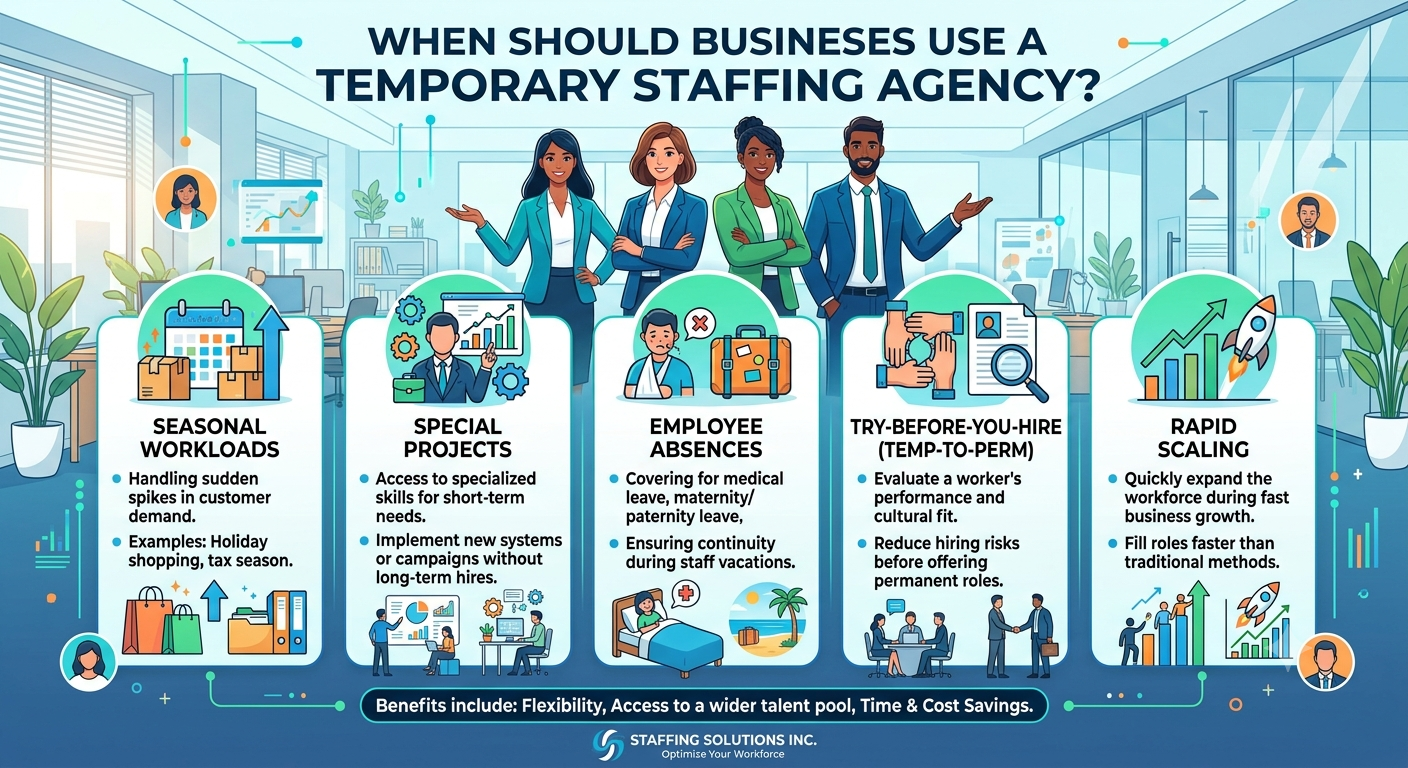
1. Seasonal or Cyclical Demand Spikes
Retail before festive season. E-commerce during sale periods. Manufacturing units ramping up before a quarterly shipment deadline. These are textbook cases for a seasonal staffing agency, where the need is real but time-bound.
Bringing on permanent employees for a three-month spike creates a severance and redundancy problem later. A seasonal staffing partner lets you scale the workforce up in weeks and release it just as quickly, without the legal or morale fallout of layoffs.
- Retail chains staffing for Diwali or year-end sales
- Warehousing and logistics teams before peak shipping windows
- Hospitality staff for wedding or event seasons
2. Sudden Attrition or Unplanned Vacancies
When a key employee resigns without notice, the gap doesn’t wait for a six-week recruitment cycle. Client deliverables still need to move. A temporary staffing agency can place a qualified professional within days, buying HR the time to run a proper permanent search without the business bleeding productivity in the interim.
3. Project-Based or Time-Bound Work
Not every business need is permanent. A new product launch, a system migration, a compliance audit, or a client project with a fixed timeline all require skilled hands for a defined period. Hiring full-time employees for work that has a clear end date leads to bench cost once the project wraps up.
Temporary staffing solves this cleanly: the right skill set, for the exact duration needed, with no long-term liability once the project closes.
4. Testing a Role Before Making It Permanent
This is where temp-to-hire staffing becomes particularly useful. Instead of committing to a full-time hire based on a resume and two interviews, businesses place the candidate on a temporary contract first.
Over that period, you evaluate actual performance, team fit, and reliability—then convert the best performers into permanent employees. It reduces mis-hire risk significantly, which matters when the cost of a bad senior hire can run into lakhs once you count recruitment fees, onboarding time, and lost productivity.
- Lower risk than a direct permanent hire
- Real performance data instead of interview impressions
- Smoother transition for both the employee and the employer
5. Entering a New Market or City
Expanding operations into a new city or region often means you don’t yet have the local hiring networks, compliance knowledge, or employer brand recognition to attract talent quickly. A regional staffing partner already has that infrastructure in place.
For businesses expanding into North India, for instance, working with an established temporary staffing agency in Delhi NCR means you get access to a pre-vetted local talent pool and someone who already understands the region’s labour compliance requirements—without setting up an internal recruitment function from scratch.
6. Cost Control During Uncertain Business Cycles
When revenue forecasts are unclear—post-funding rounds, economic slowdowns, or after a restructuring—businesses often freeze permanent hiring but still need operational capacity. Temporary staffing offers a middle path: get the work done without adding to fixed payroll costs or long-term HR liabilities.
This is particularly relevant for CFOs and COOs managing budgets quarter to quarter, where flexibility in workforce cost is as important as the work getting done.
How to Decide: A Quick Internal Checklist
Before your next hiring decision, run it through these questions:
- Is the need time-bound or ongoing? Time-bound leans temporary; ongoing leans permanent.
- Can the role wait 6–8 weeks for a full hiring cycle? If not, temporary staffing bridges the gap.
- Is there uncertainty about the exact skill set or fit needed long-term? Temp-to-hire reduces that risk.
- Does the location or skill pool fall outside your current recruitment reach? A regional staffing partner solves this faster than building it internally.
If two or more of these apply, a staffing partner is likely the more efficient route than a direct internal hire.
What to Look For in a Staffing Partner
Not all staffing agencies operate the same way, and the difference matters once you’re relying on them for compliance-sensitive placements.
- Compliance ownership — PF, ESI, labour law adherence handled on their end, not yours
- Speed of deployment — how quickly they can actually place a qualified candidate
- Industry-specific talent pools — generic databases rarely match specialised roles well
- Transparent conversion terms — clear terms if a temp-to-hire arrangement moves to permanent
The Bottom Line
Knowing when businesses should use a temporary staffing agency isn’t about outsourcing hiring altogether—it’s about matching the type of workforce need to the right hiring model. Seasonal spikes, sudden vacancies, project work, market expansion, and role validation are all situations where flexibility beats a rigid permanent-hire approach.
For HR heads and business owners managing multiple moving parts, the smarter play is knowing which situations call for speed and flexibility over long-term commitment—and building a relationship with a staffing partner before the emergency hits, not during it. Companies like Contract Staffing Hub work with businesses across sectors to handle exactly these scenarios, from seasonal ramp-ups to compliant temp-to-hire placements.