Contract Staffing vs Temporary Staffing: Key Differences for Business Leaders
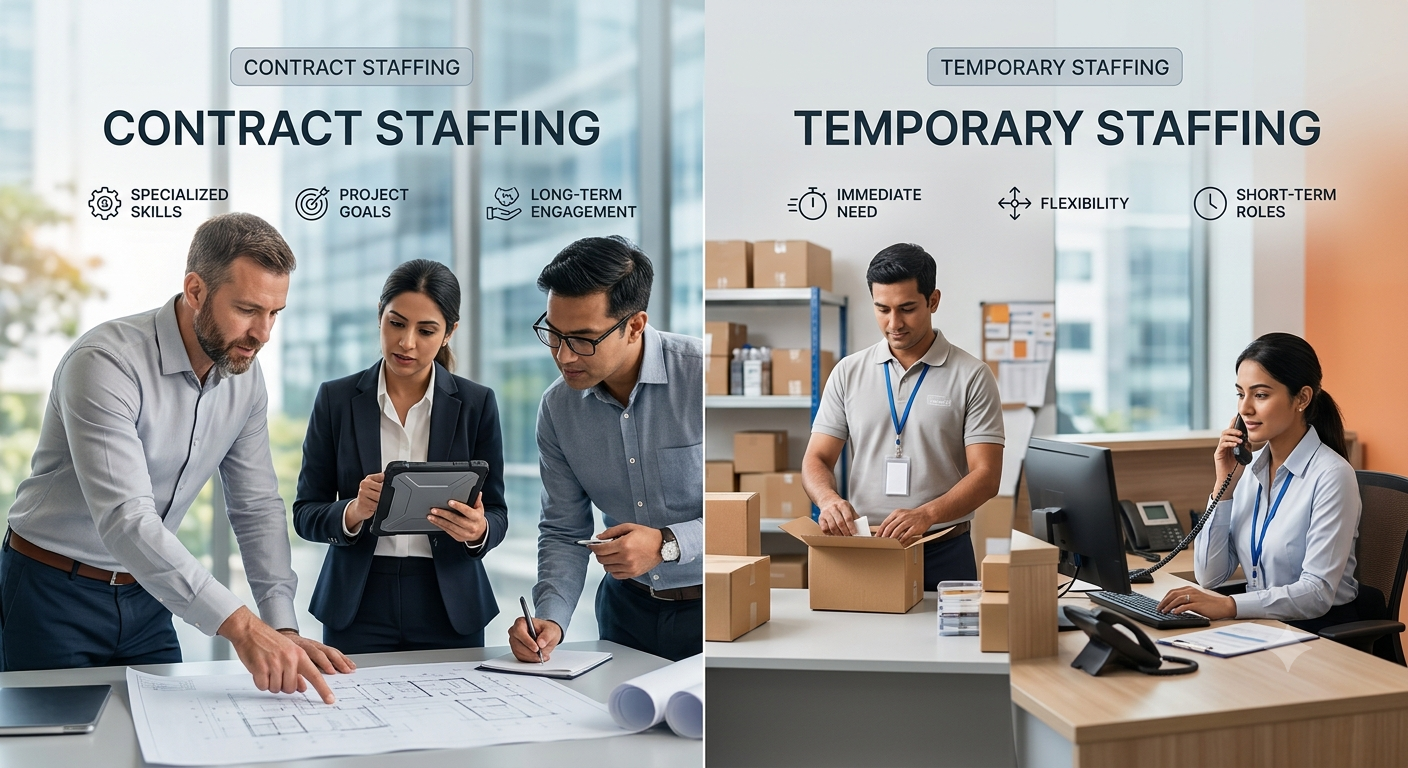
Choosing the right talent model directly impacts your operational speed, overhead costs, and delivery quality. While contract staffing and temporary staffing are often used interchangeably, confusing the two can lead to budget misallocations, compliance risks, and skill mismatches. The primary difference lies in the nature of the work: temporary staffing fills short-term operational gaps, whereas contract staffing brings in specialized expertise for targeted project outcomes.
Understanding these operational nuances helps executive leaders optimize workforce management and scale efficiently.
What is Contract Staffing?
Contract staffing involves engaging highly skilled professionals for specific, time-bound projects or deliverables. These individuals—often software engineers, project managers, or legal advisors—possess niche skill sets required to execute complex business objectives.
Organizations typically engage professionals through a specialized partner like a contract staffing agency in Delhi NCR
to source vetted talent without adding permanent headcount.
Key Characteristics of Contract Staffing:
- Specialized Expertise: Focuses on niche skills for technical, strategic, or specialized projects.
- Defined Deliverables: Governed by explicit contracts detailing project scope, milestones, and timelines.
- Flexible Duration: Engagements range from a few months to several years based on project needs.
What is Temporary Staffing?
Temporary staffing provides short-term coverage for administrative, operational, or seasonal roles. Businesses rely on a temporary staffing agency to maintain daily business continuity during peak demand periods or employee absences.
In this model, temporary employees remain on the staffing agency’s payroll while performing day-to-day duties under your direct supervision.
Key Characteristics of Temporary Staffing:
- Speed of Deployment: Quickly fills high-volume or entry-to-mid-level operational roles.
- Operational Continuity: Replaces staff on parental leave, medical leave, or sudden departures.
- Low Onboarding Overhead: Minimal specialized training required, allowing immediate integration.
Strategic Comparison: Contract Staffing vs Temporary Staffing
To determine which model aligns with your operational goals, consider these core operational factors:
| Strategic Dimension | Contract Staffing | Temporary Staffing |
| Primary Focus | Specialized project execution | Operational coverage & labor capacity |
| Skill Level | Advanced / Specialized | General / Entry-to-mid level |
| Supervision | Autonomy based on project goals | Direct, day-to-day management |
| Engagement Duration | Medium to long-term (3 to 18+ months) | Short-term (days to a few months) |
| Cost Structure | Higher rate based on domain expertise | Lower hourly or daily labor rates |
When Should Enterprise Leaders Choose Each Model?
Selecting the right staffing framework depends entirely on your current business roadmap and resource requirements.
                           [Workforce Need Identified]
                                        |
                   Is specialized expertise required?
                                  /   \
                             (Yes)     (No)
                              /         \
    [Contract Staffing Model]          [Temporary Staffing Model]
    - Niche project deliverables       - Operational vacancy coverage
    - Specialized tech/management      - Seasonal demand spikes
Choose Contract Staffing When:
- Executing Specific Initiatives: Launching an enterprise software migration, product design, or strategic audit.
- Requiring High Autonomy: You need self-directed professionals who require minimal oversight to deliver results.
- Mitigating Talent Scarcity: Accessing specialized talent pools that are difficult or costly to hire permanently.
Partnering with an established talent partner through Contract Staffing Hub
allows enterprises to deploy technical teams rapidly while maintaining fiscal agility.
Choose Temporary Staffing When:
- Managing Peak Seasons: Scaling up warehouse, retail, or customer support teams during high-demand cycles.
- Covering Leaves of Absence: Maintaining daily operations during long-term employee medical or family leaves.
- Controlling Short-Term Costs: Meeting immediate labor demands without long-term contractual commitments.
Final Considerations for HR and Business Executives
Both talent acquisition strategies offer distinct advantages for enterprise agility. By matching your operational requirements with the appropriate staffing model, business leaders can maintain lean operations, optimize budget performance, and drive project success. Review your upcoming Q3/Q4 deliverables to align your workforce strategy with expert contract staffing or flexible temporary staffing solutions today.