What Is Contract Staffing and How Does It Work?
Hiring quickly is easy to describe but difficult to execute. A company may need 20 employees for a new project, 100 workers for a business expansion, or an entire team for an operation that must start within weeks. Hiring each person permanently can increase administrative workload and long-term employment commitments. This is where contract staffing becomes a practical workforce solution.
In simple terms, contract staffing allows a company to access employees for a defined period or business requirement through a staffing provider. The staffing agency typically handles recruitment, documentation, payroll administration, and other workforce processes, while the client manages the employees’ day-to-day work.
For companies evaluating workforce flexibility, understanding what contract staffing is and how it works is important before deciding whether to hire directly or engage a staffing partner.
What Is Contract Staffing?
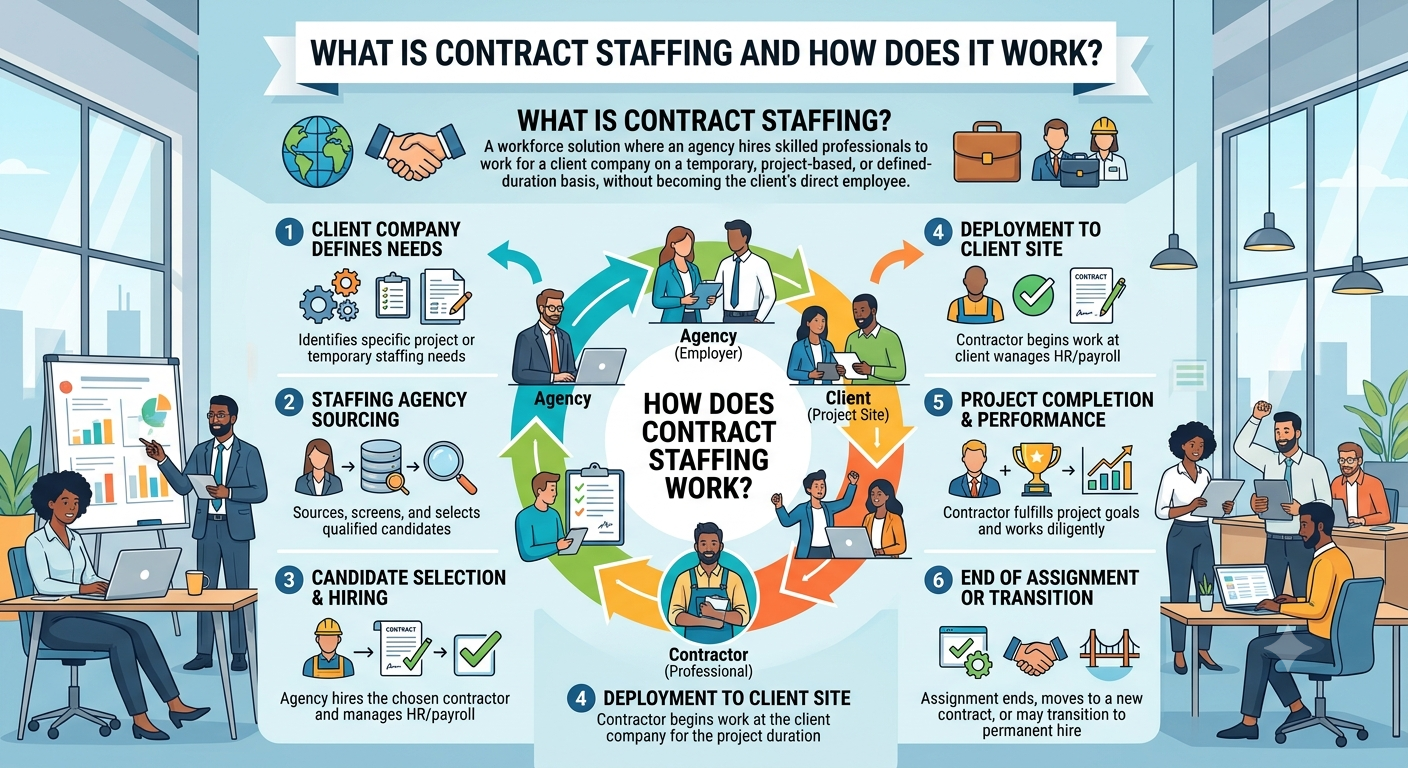
Contract staffing is an arrangement in which employees are engaged for a specified period, assignment or business requirement rather than being hired as regular permanent employees of the client organisation.
A staffing agency can source and onboard suitable candidates and deploy them to the client. Depending on the contractual structure, the staffing provider may manage payroll, attendance, statutory administration, employee documentation and other workforce responsibilities.
The model is particularly relevant when businesses need to:
- Scale teams quickly
- Handle seasonal or project-based demand
- Support new business launches
- Fill urgent workforce requirements
- Access specialised talent
- Manage large-volume hiring
- Reduce the internal administrative burden of workforce management
The important point is that contract staffing is not simply “temporary hiring.” A professionally managed arrangement can combine recruitment, workforce administration and ongoing employee support.
How Does Contract Staffing Work?
The process normally involves several parties: the client company, the staffing provider and the deployed employee.
1. The Company Defines Its Requirement
The process starts when a company shares its workforce requirement with a staffing agency.
The requirement may include job descriptions, qualifications, experience, location, salary range, number of positions, joining timeline, shift requirements and expected assignment duration.
A good staffing partner should understand the business requirement rather than simply forward resumes.
2. The Staffing Agency Sources Candidates
The agency then searches its candidate database, recruitment channels, professional networks and other sourcing platforms.
For bulk requirements, the sourcing process may involve multiple recruitment teams working simultaneously to create a sufficiently large candidate pipeline.
3. Candidates Are Screened and Evaluated
Candidates are screened against the client’s requirements before being presented.
Depending on the position, screening may include:
- Qualification verification
- Experience assessment
- Interview coordination
- Skill evaluation
- Salary discussion
- Availability confirmation
- Documentation checks
This stage matters because sending large numbers of irrelevant profiles does not solve a workforce problem.
4. Selection and Onboarding
Once the client selects candidates, the staffing provider manages the required employment documentation and onboarding process according to the agreed structure.
The employee then joins the client’s workplace or project and performs the assigned role.
5. Workforce Administration Continues
The relationship does not necessarily end after joining.
A full-service contract staffing provider may coordinate attendance, payroll inputs, salary processing, leave administration, employee documentation, statutory processes, reporting and other workforce administration.
This is one of the major differences between simply finding a temporary worker and using a managed staffing solution.
Contract Staffing Meaning: Who Employs the Worker?
One of the most important questions businesses should clarify is the employment relationship.
In an agency-based staffing model, the staffing provider may employ the worker while the worker is deployed to perform services for the client. The exact legal and contractual structure should always be established in the staffing agreement.
The client generally remains responsible for directing the employee’s day-to-day work, operational priorities and performance requirements, while the staffing provider manages the responsibilities assigned to it under the contract.
Indian labour regulations also place specific obligations around contract labour, wages, welfare and compliance. The Ministry of Labour and Employment has noted that the earlier Contract Labour (Regulation and Abolition) Act framework has been subsumed into the Occupational Safety, Health and Working Conditions Code, 2020, alongside reforms concerning contractor licensing, appointment documentation and welfare provisions.
For this reason, companies should evaluate a staffing provider’s compliance capability rather than selecting one purely on the lowest service fee.
Contract vs Permanent Employees: What Is the Difference?
The fundamental difference is the nature and structure of the workforce relationship.
| Factor | Contract Staffing | Permanent Employment |
|---|---|---|
| Workforce duration | Usually defined by assignment or agreement | Generally ongoing |
| Hiring model | Often managed through staffing provider | Direct company recruitment |
| Scaling | Easier to increase or reduce workforce according to requirement | Usually less flexible |
| Recruitment administration | Can be outsourced | Usually managed internally |
| Payroll administration | May be handled by staffing provider | Normally handled by employer |
| Workforce model | Suitable for projects, expansion and variable demand | Suitable for long-term organisational roles |
Neither model is universally appropriate. The right choice depends on the company’s workforce requirement, role, duration, operational structure and compliance responsibilities.
When Should a Company Consider Contract Staffing?
Contract staffing can be commercially useful when workforce requirements change faster than traditional recruitment processes.
Rapid Business Expansion
A company opening a new facility or expanding operations may need dozens or hundreds of employees within a short period.
Using a staffing partner can provide access to an existing recruitment infrastructure instead of building an entirely new sourcing operation internally.
Project-Based Hiring
Some projects have a defined beginning and end. Hiring permanent employees for every project can create a workforce structure that does not match actual business demand.
Contract staffing provides an alternative for defined workforce requirements.
Seasonal Demand
Retail, logistics, manufacturing, hospitality and several other sectors can experience fluctuations in workforce demand.
A flexible staffing model can help companies respond to these peaks without redesigning their entire permanent workforce.
Large-Volume Recruitment
When a company needs 50, 100, 500 or more employees, recruitment speed becomes a business issue rather than simply an HR activity.
A specialised staffing agency can coordinate sourcing, screening, documentation and deployment at scale.
What Should Companies Check Before Choosing a Staffing Agency?
Not every staffing provider offers the same level of service.
Before signing an agreement, decision-makers should evaluate:
- Recruitment capacity
- Industry experience
- Candidate sourcing capability
- Payroll infrastructure
- Statutory compliance processes
- Attendance and workforce reporting
- Employee documentation
- Replacement support
- Geographic coverage
- Client references and track record
- Commercial terms and service charges
- Escalation and account-management process
Ask the provider to explain exactly what it will manage after the employee joins.
That question often reveals the difference between a recruitment vendor and a genuine workforce-management partner.
Is Contract Staffing Only for Large Companies?
No. Contract staffing can be relevant to companies of different sizes.
A growing SME may use contract employees to build a new team. A mid-sized company may require additional employees for expansion. A large enterprise may use staffing partners to manage high-volume hiring across multiple locations.
The deciding factor is not company size. It is whether the organisation has a workforce requirement that benefits from speed, flexibility and outsourced workforce administration.
Choosing a Contract Staffing Partner
The commercial value of contract staffing depends heavily on execution.
A provider should be able to demonstrate how it sources candidates, how quickly it can deploy employees, how payroll and documentation are managed, how attendance information is collected, how employee queries are handled and how compliance responsibilities are allocated.
For businesses operating across Delhi NCR, a specialised provider such as Contract Staffing Hub’s Delhi NCR contract staffing service can be evaluated based on these practical capabilities rather than simply comparing quoted service charges.
The objective should be straightforward: build the required workforce without creating unnecessary recruitment and administration complexity.
Final Thoughts
So, what is contract staffing and how does it work? It is a workforce model that allows businesses to engage employees for defined requirements while outsourcing some or all recruitment and workforce administration to a staffing provider.
The contract staffing meaning becomes clearer when viewed from a business perspective: companies gain a mechanism for scaling workforce capacity while a specialised provider can manage recruitment, documentation, payroll and ongoing administration.
Before choosing between contract vs permanent employees, companies should consider the nature of the role, expected duration, workforce volume, operational requirements and compliance structure.
When the requirement is temporary, project-driven, seasonal or high-volume, a properly structured contract staffing arrangement can become a practical component of a company’s overall workforce strategy.